For Internal Builders & Operators Who Want to Stay Irreplaceable in the AI Age
Too Busy to Fix the Thing That's Making You Busy.That's the trap. Here's the way out.
You Already Know Enough to Use AI. You Just Don't Have Time to Figure Out Where. The Bottleneck-First System™ gives you a clear starting point — not more tools to learn.
🔒 100% Secure 256-Bit Security Encryption
There are two kinds of people navigating AI at work right now.
The first kind keeps adding tools. A new app every few weeks. Another automation that breaks. Another course they don't finish. They're not lazy — they're genuinely trying. But nothing sticks because the underlying workflow is still chaos, and AI on top of chaos just moves faster.
The second kind figured something out. Not because they had more time, more budget, or a better team.
In fact, some of the most overwhelmed operators I've talked to work inside companies with entire AI departments — and those departments still can't implement the things that actually matter.
The difference isn't resources. It's sequence.
You already know which one survives the next round of cuts.
You're Not Behind Because You're Lazy. You're Behind Because You're Too Busy to Fix the Thing That's Making You Busy.
Right now, you're probably:
Doing the same tasks over and over, even though you know they should be systemized - but never having the two hours to actually do it
Juggling 10+ tools that don't talk to each other (adding new ones hoping this one finally connects everything)
Treating everything as urgent because there’s no stable workflow to fall back on — so every day starts in reaction mode
Afraid of automating the wrong thing and making the mess even worse
Watching others build "AI teams" while you're still stuck in manual mode
Waking up already behind, unable to fully disconnect, because you know things will break the moment you step away
The hardest part to admit isn't that you're behind.
It's that every time you've tried to fix it — a new tool, a new system, a new workflow — the chaos just followed you there.
That's not a you problem. That's a sequence problem.
You're not behind because you lack tools. You're behind because the work hasn't been turned into a system yet — so every attempt at AI just automates the chaos instead of replacing it.
Here's What Staying Stuck Is Actually Costing You
Your time: Every week you spend firefighting is a week you don't spend on the work that actually builds your career. The gap between where you are and where you want to be isn't a skills gap — it's a time-trapped-in-the-wrong-work gap.
Your career: While you're buried in busywork, others are earning credibility by fixing systems and making leverage visible to leadership. The people who get promoted in the AI era aren't the ones who know the most tools — they're the ones who know exactly where AI belongs and where it doesn't.
Your job security: AI isn't going away. And the people who keep their jobs aren't the ones hiding from it or the ones experimenting with everything. They're the ones who built a system first — so AI had a clear job to do.
Your mental load: Work follows you home. You wake up already behind. You can't fully disconnect because you know things will break if you're not there. That's not a workload problem. That's a single-point-of-failure problem — and it has a fix.
Get The Builder Kit For ONLY $27
YOU’RE SAVING $773 TODAY
Get The Builder Starter Kit
for only $27
Bonuses Will Be Delivered Instantly.
Get Full Access Right Away.

🔒100% Secure 256-Bit Security Encryption

Here's The Real Problem (And Why Everything You've Tried Has Failed)
The problem isn’t AI.
And it’s not that you’re “not technical enough.”
It’s not even that you picked the wrong tools.
The problem is that AI is being applied before the work is stable.
When workflows aren’t clear, documented, or repeatable, automation doesn’t create leverage — it just accelerates the mess.
That’s why it feels like AI is happening to you instead of for you.
Not because you’re behind — but because no one showed you where to start.
Here’s what usually happens:
You feel buried in repetitive work
You hear AI can help
You add tools (ChatGPT, Zapier, Make, agents, etc.)
You try to automate something
It breaks, creates edge cases, or adds more overhead
You assume the tool didn’t work — or that you did something wrong
What’s actually happening is simpler:
AI is being layered on top of workflows that were never stabilized
Tools are connected before the process is clear
Automation is asked to solve problems that haven’t been defined yet
It’s like trying to organize a messy garage by buying more storage bins.
The bins aren’t the problem. The mess is.
No matter how powerful the tools are, the foundation matters.
Why Most AI Implementations Fail
Not because the technology doesn’t work.
But because people skip the one step that makes everything else possible:
Identifying the real bottleneck first.
Until you know:
Where work is actually getting stuck
Which workflow is creating the most downstream chaos
Which tasks are worth automating — and which create leverage when you do them
Which parts of your role AI should handle, and which parts shouldn’t
…AI stays fragile.
Most people automate chaos.
Builders stabilize workflows first.
That difference is what makes them effective — and irreplaceable.
Introducing: The Bottleneck-First System™
This is what finally made it click for me.
Instead of jumping straight to AI tools and hoping something sticks, you follow a proven methodology that identifies your single highest-impact constraint BEFORE you automate anything.
This isn’t a template or a tool.
It’s a way of seeing your role — and your operation — as a system.
Once you see this, you can't unsee it. Every time someone talks about "adding AI," you'll immediately know if they're doing it right or wasting their time.
Here's how it works:
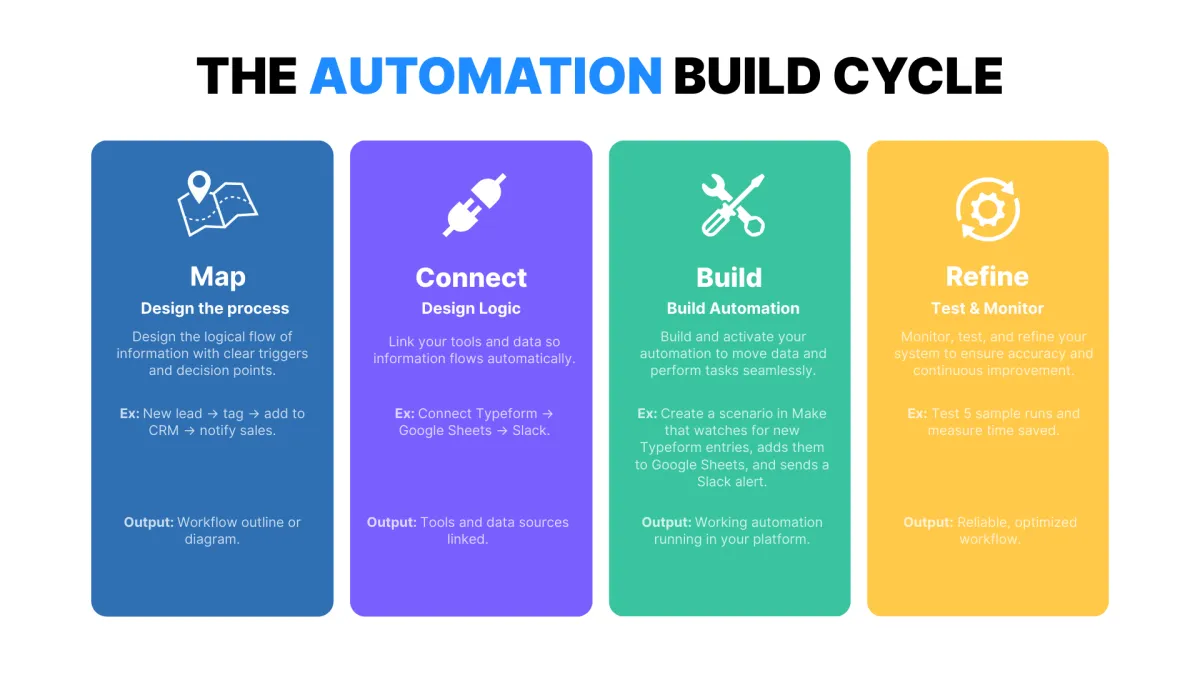
Every successful automation follows the same sequence — whether people realize it or not.
We make it explicit.
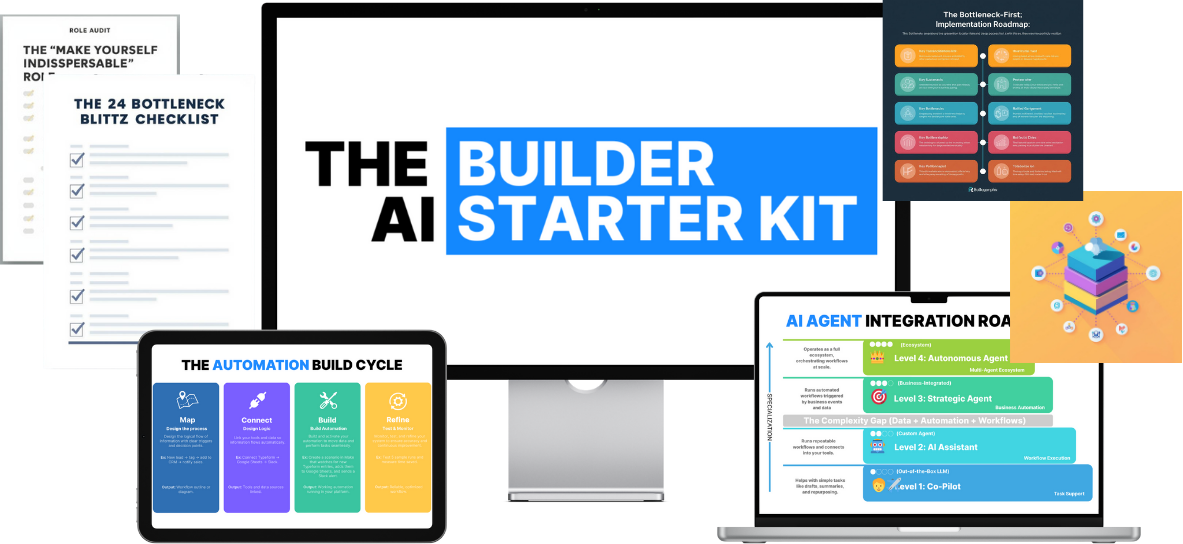
The 4-Phase Automation Build Cycle
Every successful automation follows this exact sequence:
PHASE 1: MAP ← You are here
Identify your bottlenecks, audit your engines, document your workflows, gain surgical clarity on what to fix first
PHASE 2: CONNECT
Link tools and data intentionally — only after the workflow is clear.
PHASE 3: BUILD
Apply automation to stable, documented processes.
PHASE 4: REFINE
Test, monitor, and optimize for continuous improvement
The Difference?
Most people skip Phase 1 and wonder why automation creates more work or solves the wrong problems.
Builders who use the Bottleneck-First System™ know exactly what to fix first—so when they DO automate, it actually works.
This is how you become the person they can't afford to lose.
While others are throwing AI at everything hoping something sticks, you actually know what you're doing. You become the person your boss comes to when they need to know: "What should we actually automate?"
This is the missing piece.
Why This Works
The Bottleneck-First System™ is built on a simple truth from systems theory:
"Every system has exactly ONE constraint that limits its performance. Fix that constraint, and everything else flows."
In most businesses, that constraint lives in one of three places:
Growth Engine (lead generation, nurture, conversion)
Fulfillment Engine (delivery, onboarding, execution)
Support Engine (customer communication, issue resolution, retention)
One of these engines is creating the majority of your operational drag.
The Bottleneck-First System™ helps you find it in under 60 minutes.
Then you can apply AI with precision—instead of guessing.
What This Changes for You
With the bottleneck clear, you can audit your own role and see:
Which tasks AI should handle (the repetitive, mechanical work)
Which tasks should be delegated (low-leverage but necessary)
Which tasks only you should do — the work that actually creates value
That’s how AI stops feeling threatening.
And starts feeling useful.
Not because you learned more tools —
but because you finally gave AI a system to support.
This is how you stay employed when everyone else is getting replaced.
Only a few days left

Now For ONLY $27
YOU’RE SAVING $773 TODAY
Get The Builder Starter Kit
for only $27
Bonuses Will Be Delivered Instantly. Get Full Access Right Away.

100% Secure 256-Bit Security Encryption
And I'm not the Only One..
"My life changed forever"
"Testimonial lorem ipsum dolor sit amet, consectetur adipisicing elit. Autem dolore, alias, numquam enim dolor elit." - Your Name

"Highly recommend this"
"Testimonial lorem ipsum dolor sit amet, consectetur adipisicing elit. Autem dolore, alias, numquam enim dolor elit." - Your Name
"Highly recommend this"
"Testimonial lorem ipsum dolor sit amet, consectetur adipisicing elit. Autem dolore, alias, numquam enim dolor elit." - Your Name
"Highly recommend this"
"Testimonial lorem ipsum dolor sit amet, consectetur adipisicing elit. Autem dolore, alias, numquam enim dolor elit." - Your Name
"My life changed forever"
"Testimonial lorem ipsum dolor sit amet, consectetur adipisicing elit. Autem dolore, alias, numquam enim dolor elit." - Your Name
"My life changed forever"
"Testimonial lorem ipsum dolor sit amet, consectetur adipisicing elit. Autem dolore, alias, numquam enim dolor elit." - Your Name
The Opportunity
Here's the good news:
AI can already handle a meaningful portion of the repetitive work you do every day — if you know where to point it.
Not everything.
Not randomly.
But the right work.
When AI is applied to a clear system, it can remove 30–50% of the manual load that drains your time and attention.
When it’s applied without one, it just creates more to manage.
That’s the difference most people are missing.
Right now, most teams are still “exploring AI” — adding tools, testing features, and hoping clarity appears later.
Builders do the opposite.
They get clarity first.
They stabilize the workflow.
Then they apply AI with precision.
That’s why the advantage compounds.
Once systems are in place, they’re hard to copy — and even harder to unwind.
The person who understands them becomes the reference point.
And for you personally, that creates a very real shift.
You stop being:
“the person who uses ChatGPT sometimes”
And start becoming:
“the person who knows where AI belongs — and where it doesn’t”
That’s the person managers rely on.
That’s the person brought into planning conversations.
That’s the person teams hesitate to lose.
The Builders Who Win Are Doing One Thing Differently
They're not chasing the newest AI tool.
They're not trying to automate everything at once.
They're not hoping complexity will solve itself.
They’re doing one thing well:
Identifying the single bottleneck creating the most drag — then applying AI there, deliberately.
AI is leverage.
Workflows are the fulcrum.
Bottlenecks are where you place the lever.
And once you understand that structure, you’re no longer guessing.
No matter how AI evolves, you know how to stay valuable — because you understand the system underneath it.
INCLUDED WITH YOUR ORDER
Builder Starter Kit

Bonus #1:
THE 24-HOUR BOTTLENECK BLITZ CHECKLIST | $27 Value
Bonus #2:
THE "MAKE YOURSELF INDISPENSABLE" ROLE AUDIT | $37 Value
Bonus #3:
PERSONAL AI TOOL STACK
| $47 Value
Imagine This
Imagine It's 30 Days From Now...
You open your laptop in the morning and for once, you're not immediately stressed. Because you actually know:
What matters today (and what can wait)
What should never be done manually again (and what should)
Where AI actually belongs (and where it doesn't)
Which parts of your role create real value, and which parts don’t need you anymore
Imagine:
Finishing work without carrying it in your head
You've documented the workflows that matter. They don't live in your brain anymore.
Finally trusting that things won't break if you step away
You've stabilized the constraint. The system can breathe without you.
Feeling confident saying, "This is handled"
You're not guessing anymore. You have a map.
Being the person your boss actually listens to about AI
When executives need clarity on "what should we automate?", they come to you. You're not just using AI—you're implementing it strategically.
Watching your team execute without constant questions
Because the process is clear, documented, and repeatable.
Not because you worked harder.
But because you finally fixed the right thing first.
Look, This Is About More Than Just Fixing Bottlenecks
This changes how you see your entire job.
You'll stop reacting to whatever's on fire and start seeing the actual problems.
You'll go from drowning in tools to being the person who actually knows what they're doing.
This is a completely different way of thinking about what you do.
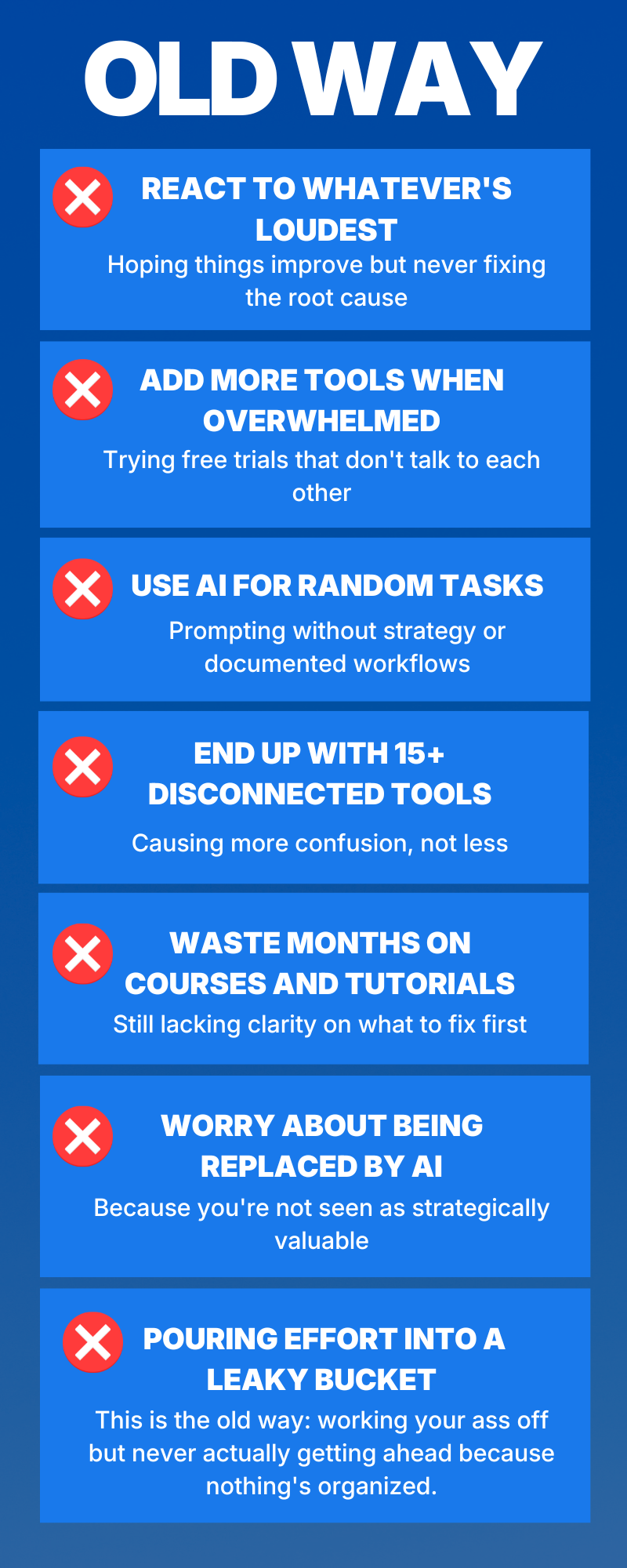
THE OLD WAY
(Why Most People Stay Stuck)
THE OLD WAY
Picture this: You wake up to 47 Slack notifications, 12 emails marked urgent, and a sinking feeling that something's about to break.
You're not sure what. But you know it's coming.
Because everything in your business depends on you remembering the steps, catching the details, being the human glue holding it all together.
So you react. You put out fires. You add another tool because someone said it would help.
Now you've got 15 apps that don't talk to each other, three different places where leads live, and a process that only works when you're the one running it.
You tell yourself you'll document it later. You'll clean it up next quarter. You'll finally build that system when things slow down.
But things never slow down.
Instead, the chaos compounds.
You try a course. Then another. You watch tutorials on automation, read articles about AI, bookmark frameworks you'll "definitely use later."
But every morning, you're back in the same place: overwhelmed, reactive, and secretly worried that if you step away for a week, everything falls apart.
The worst part?
You're working harder than ever — but you're not seen as strategically valuable.
You're seen as the person who "handles things." The operator. The doer.
Not the builder. Not the architect.
And deep down, you know: if you can't systemize this, you'll either burn out or get replaced.
This is the old way.
A treadmill that speeds up the harder you run.
Where effort pours into a leaky bucket, and nothing ever settles.
-
THE NEW WAY
(The Bottleneck-First System™)
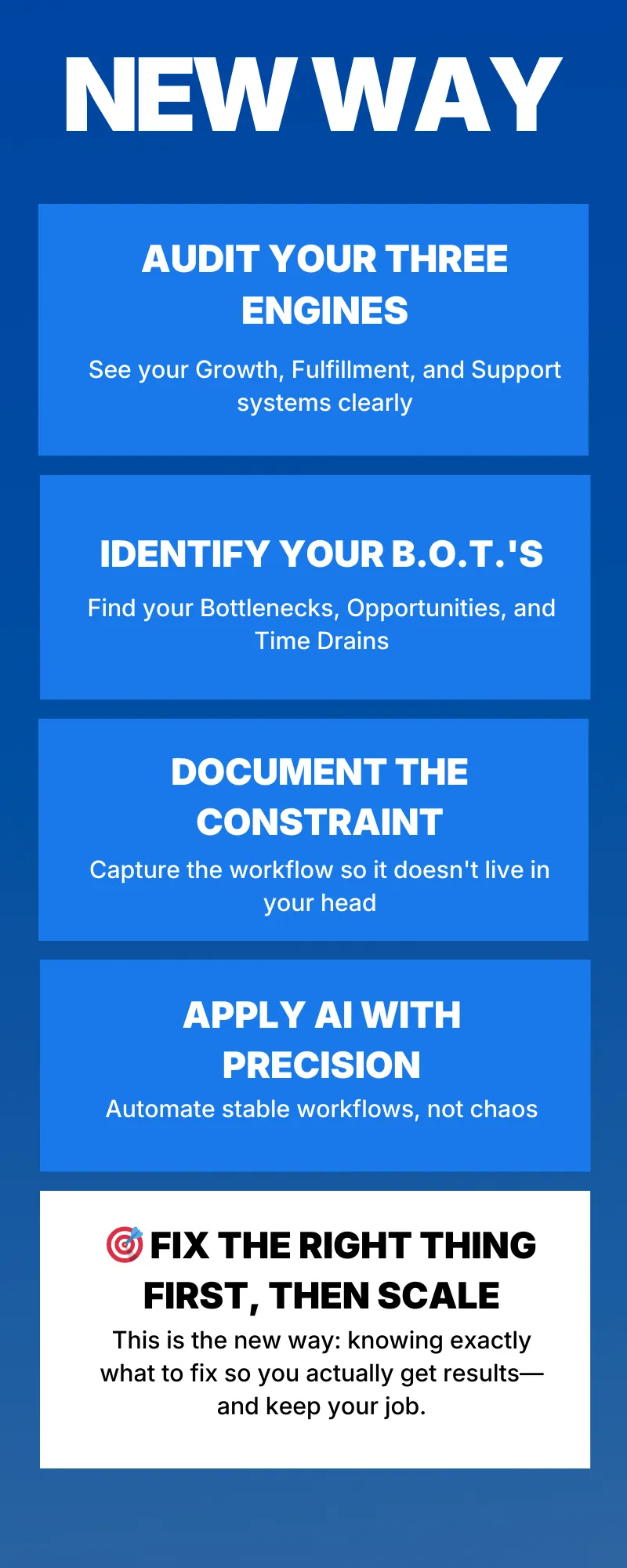
Now imagine a different morning.
You open your laptop and instead of bracing for chaos, you already know: what matters today, what can wait, and what will never hit your desk again.
Because you fixed it.
Not everything. Just the one thing that was causing most of the drag.
You documented it. You stabilized it. You let AI handle the repetitive parts.
And now it runs. Without you watching it. Without you being the bottleneck.
This is the new way.
A straight line cutting through the mess.
With the Builder Starter Kit, you're not guessing anymore.
You see your operation clearly for the first time:
Which engine is leaking. Which workflow is the real problem. What to fix first — and what to ignore completely.
You're not adding more tools. You're removing friction.
You're not automating chaos. You're building on clarity.
And here's what changes:
You finish work without carrying it in your head.
The steps are documented. The handoffs are clear. The system runs even when you're not there.
You stop being the human middleware.
AI handles the repetitive decisions. Automation moves the data. You focus on what actually matters.
You're finally seen as strategically valuable.
Not because you're doing more. But because you built something that works without you.
This isn't about working harder.
It's about working like a builder.
Identify the bottleneck. Document the workflow. Apply AI where it matters. Let it run.
Then move to the next one.
This is your straight shot:
From firefighter to builder to architect.
From reactive to proactive to strategic.
From "I'm drowning" to "I've got this."
The new way is here.
It's not a distant promise. It's a system you can start using in the next 60 minutes.
Stop pouring effort into a leaky bucket.
Start building systems that hold water.
From: Kevin Kramer
Head of Product, DigitalMarketer
Co-Founder of People that Build
Location: Santa Fe, New Mexico
If you’re reading this, you probably already know your business — or your role — could run better.
What’s missing isn’t effort. It’s a clear place to start.
I know that because I spent over a decade inside the work.
For 10 years at DigitalMarketer, I led product, operations, customer experience, and internal systems — supporting teams and workflows used by tens of thousands of customers.
That meant:
Managing cross-functional teams across product, ops, and CX
Turning tribal knowledge into documented, repeatable processes
Implementing automation across every department
Seeing what actually scaled — and what quietly broke
Across every role, I kept seeing the same pattern:
Capable people doing work a system should be doing.
Not because they were lazy.
Not because they lacked tools.
But because:
Work lived as tribal knowledge in people's heads
Every repeat task forced them to reinvent decisions from scratch
Tools were added without workflow clarity, creating more chaos
So I stopped chasing tools and started building a way to see the system first.
Over time, that work converged into a single operating principle:
The problem isn’t that people need more AI.
They need to know where to start.
That’s why I built the Builder Starter Kit.
Not to sell AI tools.
Not to push automation faster.
But to give you clarity before complexity — so when you do apply AI, it actually works.
Because I’ve seen what happens when teams skip the “Map” phase:
Automations that constantly break
Tools that don’t talk to each other
Teams that can’t scale because everything lives in someone’s head
Founders who can’t step away
Operators stuck doing work AI should handle
Success isn't about having better tools. It's about knowing where to use them.
And they've made themselves irreplaceable by knowing what actually matters.
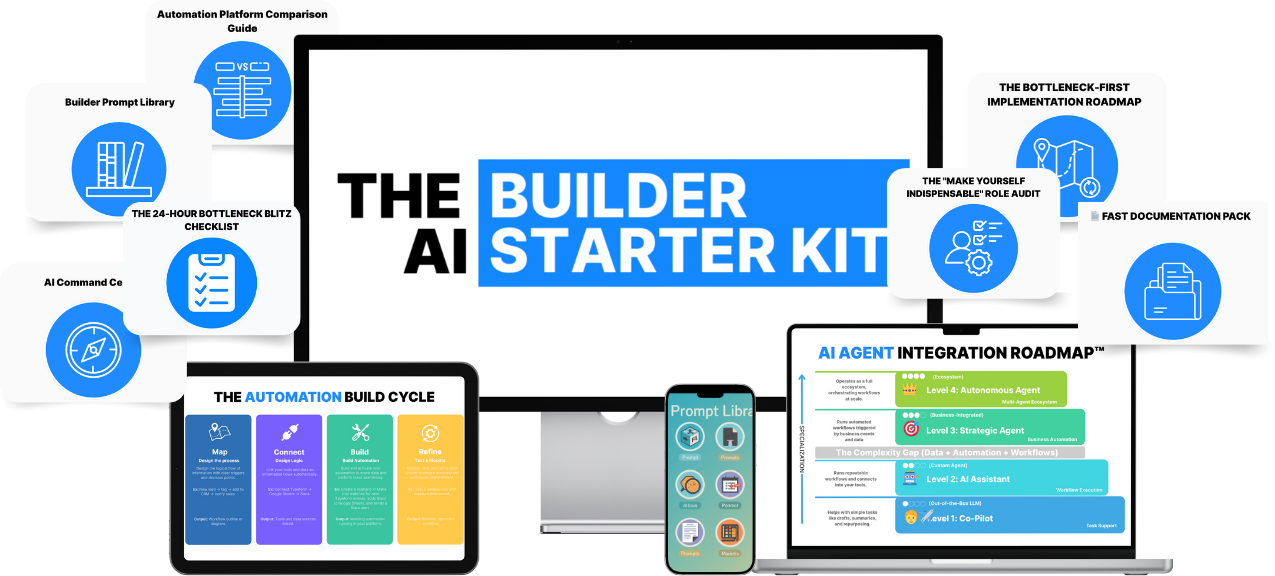
Here's Everything Inside The Builder Starter Kit
Everything you need to use the Bottleneck-First System™ and figure out your biggest bottleneck in under an hour.
The Bottle-neck First™ Framework Collection
($197 Value)
A complete, step-by-step toolkit that helps you identify, prioritize, and fix the single bottleneck creating most of your operational drag — without months of trial and error.
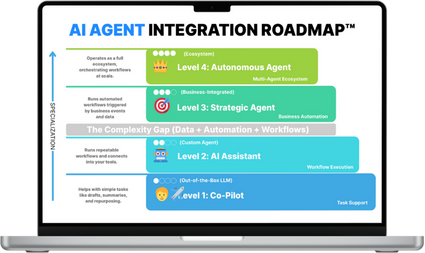
AI Agent Integration Roadmap™
($97 Value)
A clear visual roadmap showing the four levels of AI (from Copilot to Autonomous Agent), so you always know what’s appropriate now — and what to ignore.
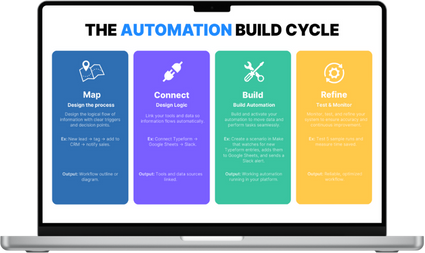
The Automation Build Cycle
($67 Value)
A proven 4-phase system (Map → Connect → Build → Refine) that ensures your automations actually work — so you never automate chaos again.
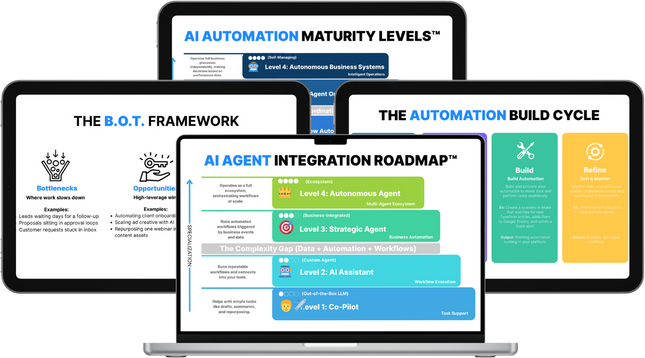
Complete Builder Framework Collection
($147 Value)
All 6 remaining frameworks in one instantly accessible bundle—the complete strategic toolkit for builders who want to move from chaos to clarity, with every tool you need to build a business that runs without you.
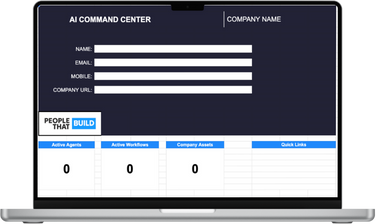
AI Command Center
($97 Value)
A guided audit of your three core engines—Growth, Fulfillment, and Support—so you can instantly spot where work is breaking down and know exactly where to focus first.
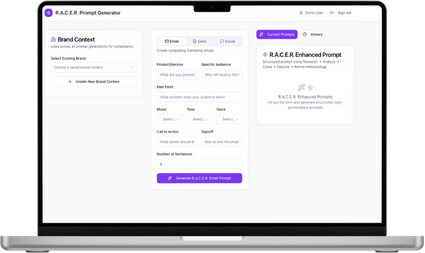
RACER Prompting Framework
($67 Value)
A 5-step system for getting 10x better results from AI—so you can research, analyze, clone, execute, and refine any workflow or content with clarity and confidence, instead of relying on random prompts.
Plus, Buy Today
And Also Get:
Bonus #1
THE 24-HOUR BOTTLENECK BLITZ CHECKLIST
($27 Value)
Go from "I don't know what's broken" to "I know exactly what to fix" in just 24 hours.
Bonus #2
THE "MAKE YOURSELF INDISPENSABLE" ROLE AUDIT
($37 Value)
Identify which of your tasks should stay with you and which should be delegated or automated.
Bonus #3
PERSONAL AI TOOL STACK
($27 Value)
Get our team's personal list of AI tools, prompts, and workflows they use daily to run their business.
Bonus #4
The Bottleneck-First Implementation Roadmap
($37 Value)
A step-by-step 30-day plan to fix your first bottleneck and build momentum for the next one.
Total Real-World Value: $800
TODAY'S SPECIAL PRICE:
JUST $27
You Save: $773
100% Secure 256-Bit Security Encryption

14-Day Clarity Guarantee

Use the system. Follow the frameworks. Watch the training. If in 60 minutes you don't have a crystal-clear view of:
Which engine is leaking (Growth, Fulfillment, or Support)
Which workflow is your #1 bottleneck
Exactly what to fix first
Which parts of your job make you irreplaceable vs. which should be automated
...you're protected.
Just send one email to support and you'll get a 100% full refund.
You have to actually use the system.
If you try it and it doesn't deliver the clarity we promised, we'll refund your money.
No questions. No friction. No stress.
You either get clarity in under 60 minutes, or you get your money back.
We wouldn't offer this if we weren't sure it works.
WARNING!
The AI Advantage Window Is Closing

Most people miss this...
Look, we've got maybe 18-24 months before everyone figures this out. Right now, the people who get it have a huge head start.
Right now, while most businesses are still "exploring" AI or randomly adding tools, the builders who gain clarity NOW will have systems in place that take competitors YEARS to replicate.
And for you? This is your shot to make yourself irreplaceable.
While others worry about being replaced by AI, you'll be the one implementing it strategically. You'll be the person your boss turns to for clarity.
But This Window Is Closing Fast
Every month, more people figure this out.
Every quarter, the competitive advantage shrinks.
Every day you wait, someone else is:
Identifying their bottlenecks while you're still guessing
Documenting their workflows while you're still reacting
Applying AI with precision while you're still adding random tools
Making themselves irreplaceable while you're still worried about job security
The real cost isn't the $27.
It's spending the next year watching other people get ahead while you're still stuck.
It's the career positioning you'll miss while others become the go-to people for AI.
This Offer Won't Stay at $27 Forever
We're adding more tools, frameworks, and training every month—and the price will increase to reflect that value.
But more importantly:
Every day you wait is another day without clarity.
And when everything's moving this fast, knowing what to do is the only thing that matters.
Whatever happens with AI, you need to make sure you're not replaceable.
This is how.

Ready? Here's What To Do:
Step 1 Click the button below and enter your information
Step 2 Get instant access to the Builder Starter Kit
Step 3 Identify your first bottleneck in under 60 minutes
Step 4 Finally know exactly what to fix first
Step 5 Become the person your boss actually trusts with AI decisions
100% Secure 256-Bit Security Encryption
Only a few days left

YOU’RE SAVING $867 TODAY
Join The Builder Starter Kit
for only $27
Bonuses Will Be Delivered Instantly. Get Full Access Right Away.
100% Secure 256-Bit Security Encryption
Frequently Asked Questions
Who is this for?
The Builder Starter Kit is perfect for overloaded operators, founders, and internal leaders who want to finally get clarity on what to fix first, document their workflows, and build a business that runs without them.
Q: How long will it take to see results?
Most people get clarity on their #1 bottleneck and what to fix in under 60 minutes. You can complete the core audits and action steps in a single afternoon—even if you’re starting from scratch.
What if I’m not “tech-savvy” or good with AI?
No problem! The Builder Starter Kit is designed for non-technical builders. You don’t need to know code or have any AI experience—just follow the step-by-step frameworks and use the copy-paste prompts.
What if I’ve already tried other AI tools or automation courses?
This isn’t another tool or generic course. The Builder Starter Kit gives you the exact frameworks and clarity to know what to fix first—so you stop automating chaos and start building systems that actually work.
Do I need to buy any expensive software to use this?
No. All the frameworks, templates, and prompts work with free or low-cost tools (like Google Docs, ChatGPT Free, and Notion). You can upgrade later, but you don’t need to buy anything extra to get results.
Is this a subscription or a one-time payment?
It’s a one-time payment of $27. You get instant, lifetime access to all frameworks, templates, and future updates—no recurring fees.
What if I get stuck or have questions?
You’ll get access to our support team and a private community of builders. Plus, the included checklists and templates make it easy to take action—even if you’re overwhelmed or short on time.
What comes after the Builder Starter Kit?
Once you’ve fixed your first bottleneck, you can move up to Builder Plus for plug-and-play workflows and AI agents, or join Builder Hub Pro for weekly workflow drops, advanced automations, and community support.
100% Secure 256-Bit Security Encryption

Still on
the fence? Remember...
You're protected by our 30-day money-back guarantee
You get $894 worth of value
This price won't last
The only way you can lose is by not taking action today
100% Secure 256-Bit Security Encryption
Bonus #1:
THE 24-HOUR BOTTLENECK BLITZ CHECKLIST
Go from "I don't know what's broken" to "I know exactly what to fix" in just 24 hours.
Bonus #2:
THE "MAKE YOURSELF INDISPENSABLE" ROLE AUDIT
Identify which of your tasks should stay with you and which should be delegated or automated
Bonus #3:
PERSONAL AI TOOL STACK
Get the team's personal list of AI tools, prompts, and workflows they use daily to run their business.
Bonus #4:
THE BOTTLENECK FIRST IMPLEMENTATION ROADMAP
A step-by-step 30-day plan to fix your first bottleneck and build momentum for the next one.
100% Secure 256-Bit Security Encryption
Only a few days left
Now For ONLY $27
🔒100% Secure 256-Bit Security Encryption

Copyright © 2026 | People That Build | Privacy Policy | Terms & Conditions | All Rights Reserved
This site is not a part of Facebook™, Meta™, or Google™, and is not endorsed by Facebook, Meta, or Google in any way. Facebook and Google are trademarks of their respective companies.
ABOUT THE TRAINING: People That Build exists to help operators, internal leaders, and founders build better systems for their work using practical workflows, automation, and AI-enabled tools. This training is designed to help you identify bottlenecks, reduce manual work, and begin replacing repetitive tasks with clearer systems. The content is practical and focused on real-world implementation, not theory. At the end of the training, you may be invited to access additional tools, resources, or programs that help you implement what you’ve learned more quickly. These offers are optional. You are not required to purchase anything to benefit from the training, and you are free to leave at any time.
EARNING AND RESULTS DISCLAIMER: This website and the materials it provides share operational frameworks, workflow strategies, and examples of how systems and automation can be applied inside a business. We make no guarantees regarding income, savings, productivity gains, or business outcomes. Results vary based on many factors, including your role, existing systems, experience, effort, and the environment in which you operate. Any examples shared are illustrative only. They are not promises or predictions of results you will achieve. You understand and agree that you are responsible for evaluating whether the information provided is appropriate for your situation and for the results of any actions you take.
LIABILITY DISCLAIMER: By using this website and any materials it provides, you acknowledge that you are solely responsible for how you apply the information. People That Build is not responsible for any outcomes, decisions, or consequences that result from your use of the content, tools, or recommendations provided. You agree to perform your own due diligence before implementing any workflows, systems, or operational changes. This content is provided for educational purposes only and does not constitute legal, financial, tax, or professional advice. Always consult a qualified professional when making decisions that impact your business or finances.
REFUND POLICY: If a paid product or program is offered, the applicable price and refund terms will be clearly stated at checkout. Where a refund policy applies, it exists to support genuine buyers who attempt to use the material and determine it is not a fit. Refund requests must follow the terms outlined at the time of purchase.